A R G O N A U T A
ARGONAUTA
Matea ŠabiĆ SabljiĆ
transdisciplinary
visual artist
she/pirate
& PIRATE SOLIDARITY
INTERVENTION AT
OMIŠ CITY MUSEUM
/ "PIRATE SOLIDARITY"
ALMISSA OPEN ART FESTIVAL 2025
10.08.25.-13.08.2025.
Curator of Almissa Open Art 2025: artist Igor Grubić
Participants: Đorđe Balmazović (Škart) • Arkadiy Kots Band • Boris Burić • Ben Cain • Nemanja Cvijanović • Darko Fritz • Flavio Favelli • Igor Grubić • Marijan Molnar • Ivan Ramljak • Rena Rädle & Vladan Jeremić • Rosy Rox • Matea Šabić Sabljić • Jure Sabljić • Driton Selmani
The 16th Almissa Open Art Festival, “Pirate Solidarity”, brings together local and international artists whose works question utopian communities, solidarity, and the role of art in social change.
In 2025, Almissa Open Art Festival was held under the title Pirate Solidarity, inspired by the legends of the Omiš pirates who once created a unique commune – a nest of resistance and togetherness where laws of mutual care and justice prevailed. For centuries, the town of Omiš resisted powerful forces, including the Venetian Republic, remaining a symbol of freedom, courage, and collective strength. It is precisely on this historical and mythical foundation that the festival program was built, reflecting on today’s world marked by social inequalities, crises, wars, and the loss of shared values.
The Pirate Solidarity festival gathers local and international artists who, through exhibitions, installations, public space interventions, and film screenings, explore ideas of utopian communities, collective care, and resistance. In this way, art becomes a means of connection, transformation, and struggle for a more just society.
Through a diverse program, visitors were invited to reflect on what solidarity means today, how we can rebuild communities that foster creativity, equality, and freedom, and how artistic practices can open space for new visions of the future.

BRODI/ONA “SHE/PIRATE” (2025.)
INTERVENTION IN THE OMIŠ CITY MUSEUM
MATEA ŠABIĆ SABLJIĆ
WANTED! SHE PIRATE OF OMIŠ! While the inhabitants of Omiš, passionate lovers of their pirate nest, strongly identify with their pirate history, and even with the Lestrigons, the Omiš area was not only traversed by Odysseus* and the Omiš pirates, but also by the Illyrian pirate queen Teuta, who commanded pirate fleets as early as 300 BC, from the Neretva River across the central Dalmatian islands all the way to Epirus in Greece. Thus, the Neretvan pirates (9th–11th century) and the Omiš pirates (12th–13th century) are considered Teuta’s successors. Historical sources describe her as “Wise as a serpent, brave as a lion, and beautiful as a fairy.” Even today, the legend lives on of Teuta saving fishermen during a great storm. To this day, 2300 years later, fishermen at the mouth of the Neretva still say: “If the wind rises, Teuta come for us!”
I am searching for the story of the female pirate of Omiš, still unknown, but I am certain she existed… As Jo Stanley writes in her book Bold in her breeches: “We were and are at sea, just as we were and are on land.” It is quite possible she disguised herself as a man to participate equally in the pirate society of the 12th and 13th centuries, remaining undiscovered until today. She may be hidden among the names of pirates in historical documents, waiting to be revealed. There is a recorded story of the local heroine Mila Gojsalić, a girl from the nearby Poljica Republic, who in the 16th century saved Poljica from the Turkish army by setting fire to a gunpowder store. August Šenoa wrote about her, Ivan Meštrović sculpted her figure, and Jakov Gotovac composed the opera Mila Gojsalića in 1951. She is often linked to resistance and courage similar to that of the pirates.
While Meštrović’s statue of Mila Gojsalić watches over the Cetina canyon, “Teuta” together with female pirates and maritime heroines sails into the Omiš City Museum, evoking a parallel history, largely invisible and unknown: the history of sea heroines who, despite prohibitions and prejudices, engaged in piracy, sailed the seas, built ships, and explored the maritime world.
Although most pirates in history were men, there are about a hundred known examples of female pirates. Some were pirate captains, others commanded entire fleets. Among the most powerful were Zheng Yi Sao (18th–19th century) and Huang Bamei (20th century), both leading tens of thousands of pirates. On many ships during the golden age of piracy, women were considered bad luck. Many famous female pirates, such as Anne Bonny and Mary Read (18th century), disguised themselves as men. Since the gender of many female pirates was only revealed after capture, it is assumed there were more women in piracy than preserved sources indicate. Female pirates played an important role in shaping social perceptions of women — often as symbols of resistance, freedom, and the redefinition of gender norms. They challenged stereotypes, defied patriarchy, and showed that women could be as brave and strategic as men. Their stories influenced culture and literature, becoming part of folk tales, ballads, and later novels, often portrayed as fearless and independent. From Teuta, the Illyrian pirate queen, to Grace O’Malley of Ireland, Anne Bonny and Mary Read of the Caribbean, and Ching Shih, the most powerful pirate in history, female pirates appeared across the world. Some, like Sayyida al-Hurre of North Africa, were also political leaders who used piracy as resistance against colonialism. In the 20th century, stories of female pirates sometimes became symbols of feminism and women’s freedom. While pirates often represented escape from wage slavery, female pirates illustrated escape from gender subordination. Their stories serve as archetypal examples of the struggle for freedom, autonomy, and equality against class, gender, and political constraints.
Since 2018, I have been independently building my own “utopian” boats by hand, as a functional mobile interactive installation in constant construction and expansion: the fleet BRODI/ONA. I build them in honor of maritime heroines who, despite prohibitions and prejudices, sailed the seas, built ships, and explored the maritime world — from pirate queens and female pirates, sailors and shipbuilders of antiquity, often disguised as men due to the belief that “a woman is bad luck on a ship,” to the pioneers of the 20th century who circumnavigated the globe, participated in races, welded ships during world wars, fought for women’s rights to education and work in technical fields, designed and constructed ships as engineers and architects, captained vessels, and contributed to the foundation of ocean science and marine conservation. In this way, they pushed boundaries and contributed to a more equal society.
My research — into which women participated in the maritime world throughout history — is presented as interventions into maritime history through maritime museums, so that alongside the official history, one can also read the parallel “unofficial — women’s history,” which was present but invisible, preserved mainly in newspapers or memoirs. Continuing the scholarly work of Hanna Hagmark-Cooper, Åland Maritime Museum, Finland: “Is there place for women in maritime history?”, I also pose the question: “Is there room for women in maritime history?” My interventions in maritime museums (Split Maritime Museum 2021, Dubrovnik 2022, etc.) take the form of museum labels with short biographical notes of women connected to the maritime world, camouflaged as museum artifacts, redefining the permanent exhibition. They do not present official history but rather an intervention — an attempt to “make room” for women in maritime history, highlighting the strength and significance of their contributions and making their presence visible.
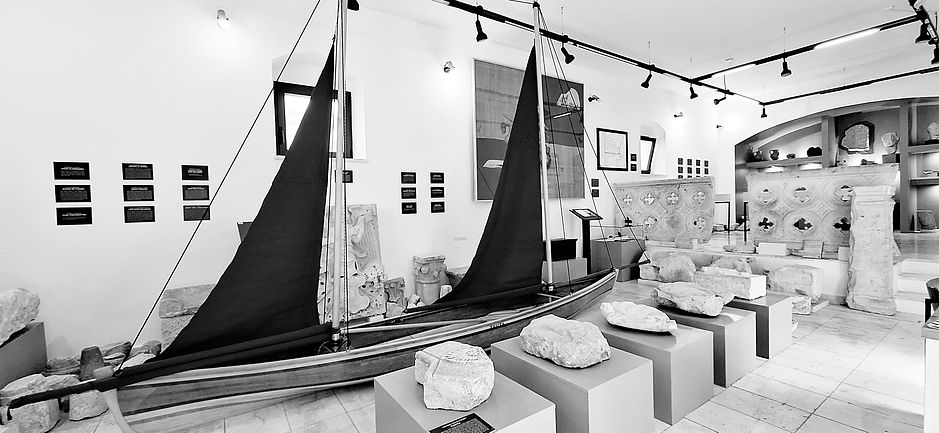
In the Omiš City Museum, referencing the history of Omiš as a true pirate nest, I intervene with the installation PIRATES/ONA. I exhibit the boat “TEUTA” from the BRODI/ONA fleet (2018–), which I built by hand in honor of the pirate queen of the Adriatic, ruler of the Illyrian kingdom in the 3rd century BC. Her fleet controlled the Adriatic, and her pirate attacks on Roman ships shook the Roman Empire. Teuta was not a mere curiosity — she was a tactician, diplomat, and pirate whose decisions shaped history. On the museum walls, I place labels with short biographical notes of female pirates worldwide. In the museum courtyard and along the street, I install 150 flags with short biographical notes of maritime heroines from history to the present.
Through my artistic work — research, interventions in history, building the BRODI/ONA fleet, creating spatial installations, and performative aspects — I present the parallel history and presence of women at sea, reshaping, questioning, and reinterpreting our understanding of history and social roles. By building boats and intervening in maritime museums with biographies of maritime heroines, I illuminate parallel, invisible, and often neglected narratives. I compose a cartography of invisible biographies of real women, inviting the audience on a journey to discover true stories and add new examples, becoming participants in bringing voices from the past into the present for the future. Alongside the history of sailors, captains, shipbuilders, explorers, and pirates, despite prohibitions and prejudices, there has always coexisted the history of female pirates, sailors, captains, shipbuilders, and explorers.
Matea Šabić Sabljić
GUSARI/ONA
INTERVENCIJA U GRADSKI MUZEJ OMIŠ
11.08.2025.u 19h, do 24.08.2025.
ALMISSA OPEN ART 2025
“PIRATSKA SOLIDARNOST”
KUSTOS IGOR GRUBIĆ
10.-13.08.2025.


